
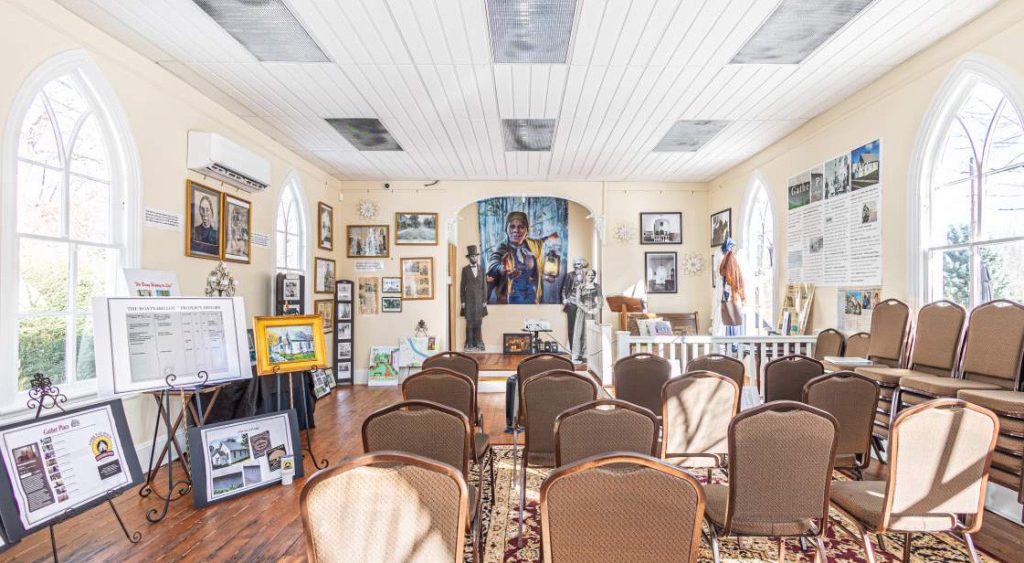
Gather Place Museum
Photograph provided by Visit Bucks County
Remembering the Underground Railroad
February is Black History Month, and Bucks250PA invites readers to reflect on a powerful chapter of local and national history: the Underground Railroad in Bucks County. Long before freedom was guaranteed by law, this region became part of a quiet but determined network of resistance shaped by African American communities, abolitionists, faith leaders, and everyday citizens who believed that liberty was worth the risk.
Secrecy was essential, so the Underground Railroad left few written records. What we know today comes from documented accounts, court records, church histories, oral traditions, and ongoing research. Together, these sources reveal that Bucks County’s geography, bordering the Delaware River and connecting Pennsylvania to New Jersey and points north, made it a vital passage for freedom seekers during the 18th and 19th centuries.
Community Churches
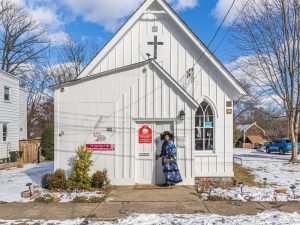
Faith groups were central to Underground Railroad activity, particularly African Methodist Episcopal and Baptist congregations that anchored Black communities across the county. Bethlehem African Methodist Episcopal (AME) Church in Langhorne, one of the oldest African American churches in the region, is documented as a safe haven connected to abolitionist Robert Purvis, who aided thousands of freedom seekers along the Delaware River.
Additional congregations associated with this history include Mount Gilead A.M.E. Church, the first all–African American congregation in Bucks County. The Historic AME Church in Yardley, now home to the Gather Place Museum, was built in 1877 on a site of worship dating back to 1817, when the Free People’s Church of Yardleyville gathered together in a Quaker hay press barn. Originally known as “The Colored Church,” it was founded by African American ministers and congregants from Trenton, New Jersey, who purchased this land in Yardleyville. The Bensalem African Methodist Episcopal (AME) Church, founded in 1820, is the oldest African American church in Bensalem and a former Underground Railroad safe station.
Abolitionist Robert Purvis, one of the founders of the American Anti-Slavery Society, rowed enslaved people up the Delaware River from Philadelphia to seek refuge at the church and his nearby farm. He is estimated to have helped approximately 9,000 fugitives escape, making him one of the most significant figures associated with abolitionism in Bucks County. Purvis also played a key role in securing freedom for fugitive slave Basil Dorsey during a court trial in Doylestown in the 1830s. Another runaway slave, Leroy Allen of Roanoke, Virginia, found sanctuary at the church before joining the Union Army to fight for his freedom; he later settled in Bensalem and is buried at Bensalem AME Church.
All of these institutions provided sanctuary, support and remain active stewards of Black history today.
Homes, Taverns, and Meeting Houses
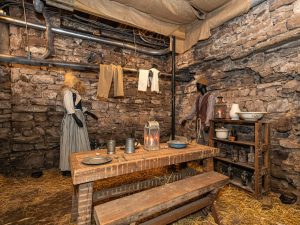
Beyond churches, freedom seekers often relied on inns, taverns, meeting houses, and private homes, many of which still stand today. The 1870 Wedgwood Inn in New Hope, a Victorian-era property, is associated with an underground passage connected to canal routes northward.
In Doylestown, 105 East State Street, also a private residence, was once home to a Baptist minister and anti-slavery advocate Samuel Aron, who is believed to have sheltered fugitives.
Quaker communities likewise played an important role, members of the Buckingham Friends Meeting House formally rejected slaveholding in the 18th century and later hosted anti-slavery lectures following the abduction of Benjamin “Big Ben” Jones.
The Continental Tavern in Yardley, known historically as the Continental Hotel, is associated, along with nearby mills and homes, with Underground Railroad activity and remains an important landmark connecting past and present.
Gathering Places for Resistance and Reform
Public gathering spaces also played a role in advancing abolitionist ideas. The Newtown Theatre, originally known as Newtown Hall, hosted anti-slavery meetings and lectures in the mid-19th century, with noted abolitionists, including Frederick Douglass and Lucreitia Mott.
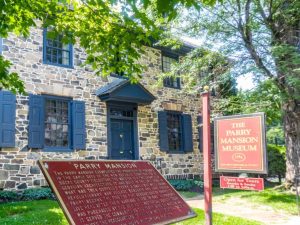
In New Hope, the Parry Mansion Museum, operated by the New Hope Historical Society, offers insight into life along the Delaware River during the era when freedom seekers passed through the town. Together, these sites tell a story of collective courage.
Communities
Langhorne (formerly Attleboro) was home to one of the earliest free Black communities in Bucks County and served as an important link between Pennsylvania and New Jersey routes. African American men from the area later served in the Union Army, with several laid to rest in Bucks County cemeteries, silent witnesses to a long struggle for freedom and citizenship.

River towns were essential waypoints along the road to freedom. Bristol Borough provided shelter and assistance to freedom seekers traveling north, while New Hope marked the final Bucks County crossing into New Jersey. Today, the Harriet Tubman Memorial Statue along the Bristol waterfront honors Tubman’s leadership and the countless unnamed individuals who followed similar paths toward freedom.
Yardley’s historic core includes several locations believed to have served as hiding places, including homes and churches near the canal and river. One such place was built in 1831 by Quaker Aaron LaRue, the Canal Shoppe at 34 East Afton Avenue along the historic Delaware Canal served canal boat crews and before the Civil War, functioned as an Underground Railroad station, providing daytime shelter and food and hiding escaped enslaved people in canal boats, as documented by the Yardley Historical Association.
In Upper Bucks County, the Richard Moore House in Quakertown, now a private residence at 401 S Main Street, became one of the most significant stations in the region. Moore and those who assisted him helped hundreds of freedom seekers despite the long distances between stops.
Quakertown continues to preserve this history through organizations such as the Quakertown Historical Society, located in a historic 19th-century barn highlighting the area’s cultural and industrial past.
Reliving History
The Underground Railroad was not a single route or organization, but a network built on trust, cooperation, and moral conviction. Its legacy is inseparable from the broader African American history of Bucks County, from Revolutionary War service to Civil War enlistment and ongoing contributions that continue to shape the region today. Below are several ways to celebrate Black History Month in Bucks County.
Observing Black History Month in 2026
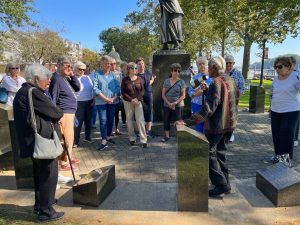
The African American Museum of Bucks County (AAMBC) offers several opportunities to explore the region’s Underground Railroad history during Black History Month. Programs include Slavery, Friends, and Freedom in Bucks County, a lecture series by historian Pat Mervine, guided Underground Railroad bus tours across Lower and Central Bucks County, and a partnership with the Newtown Theatre for a performance of Frederick Douglass: The Self-Made Man & The Work of Rebuilding a Nation.
Gather Place Museum offers immersive, place-based programs that center Black voices and connect local Underground Railroad history to national movements for freedom and justice. During Black History Month 2026, and in recognition of America’s 250th anniversary, programming includes lectures on Frederick Douglass and Rosa Parks, a dedicated presentation on the Underground Railroad, and a powerful first-person reenactment of Harriet Tubman. Designed for schools, libraries, civic groups, and community organizations, these programs invite audiences to reflect on liberty, civic courage, and the ongoing work of democracy through stories rooted in Bucks County’s landscape.
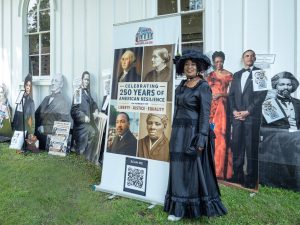
Shirley Lee Corsey, PCN Interview at Gather Place
Photograph provided by Cindy Fatsis

In collaboration with The Rural History Confederation (RHC), Pennsbury Manor will host Telling the Whole Story: Interpreting Difficult Histories for America 250 on Saturday, February 7, 2026 in the Visitor Center. This half-day workshop supports museums and historic sites in interpreting complex histories of race, religion, and nation-making in thoughtful, community-centered ways. Shirley Lee Corsey will address the legacies of race and racism in founding narratives, Doug Miller will explore who was included, and excluded, in definitions of “America” in 1776, and Devin Manzullo-Thomas will discuss interpreting faith and religious life around the 250th anniversary. Participants will gain practical tools and examples to lead inclusive, meaningful conversations at their sites.
As Bucks250PA looks toward the nation’s 250th anniversary, these stories remind us that the pursuit of liberty has always been complex and unfinished. By exploring Underground Railroad sites, supporting local museums, and participating in Black History Month programs, we honor not only the past, but the people and communities who keep this history alive. In doing so, we gain a deeper understanding of our shared past, and our shared responsibility to carry its lessons forward.